


Most small businesses have a website. Very few have one that actually earns its place.
That's not an exaggeration. For most small and medium-sized businesses, a website is something you're supposed to have — like a business card or a sign above the door. You hire someone to build it, you make sure it looks decent, and then you move on. Job done.
The problem is that mindset treats your website as an expense rather than an asset. And when you treat it as an expense, you make decisions accordingly. You optimize for cost, not outcome. You hire the lowest bidder, pick a template that looks good enough, and never really ask whether the thing is actually working.
Here's the question most businesses never ask: of all the people who visit your website, how many of them actually do something?
The Gap Nobody Talks About
According to WordStream, the average website converts at around 2.35%. That means out of every 100 people who land on your site, roughly 97 leave without taking any action at all. The top 10% of websites, however, convert at 11.45% or more, nearly five times the average. That gap isn't about luck or industry. It's about intent. The businesses at the top built their websites to convert, not just to exist.
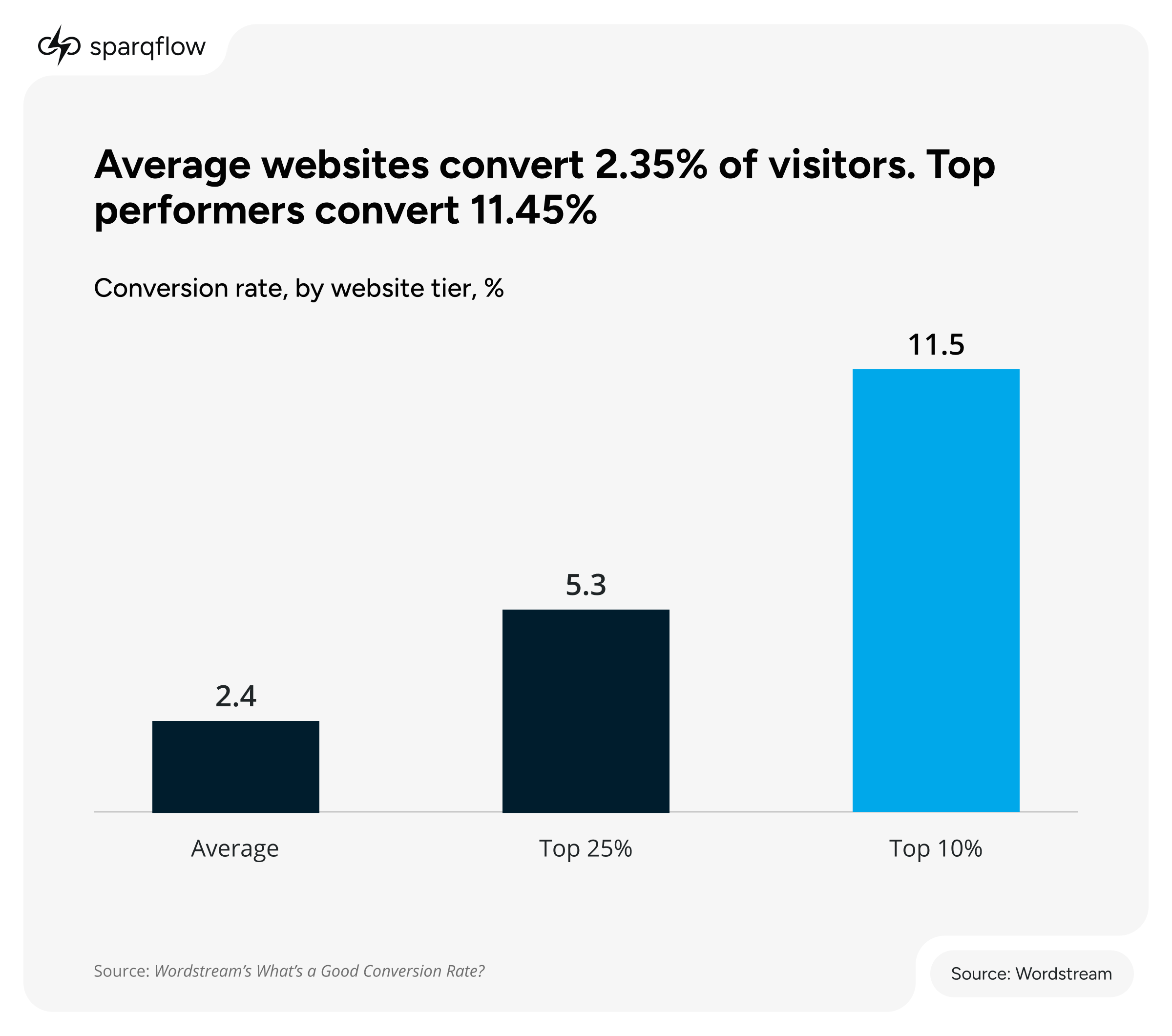
What makes this even more striking is where businesses choose to spend their money. According to Econsultancy, for every $92 spent acquiring customers, only $1 is spent on converting them. Think about that for a moment. Businesses pour money into ads, SEO, and social media to drive traffic, and then send that traffic to a website that was never optimized to do anything with it. It's like spending a fortune on a billboard and then directing people to a store with a locked front door.
What Conversion Actually Means
Here's where most web design conversations go wrong. Conversion gets treated as a single concept, usually a button that says "Buy Now." But what conversion actually means depends entirely on your business.
For a plumber or an HVAC company, conversion is a phone call. The customer has a problem right now, they want it solved today, and they expect to pick up the phone. A contact form is friction. A phone number front and center is conversion.
For an e-commerce store, conversion is an order. The entire site architecture, from product pages to checkout, exists to remove every possible obstacle between a visitor and a completed purchase.
For businesses selling higher-value or more complex services, the right conversion is getting the prospect to book a call. A short, well-designed intake form means you show up to that first conversation already knowing what matters.
Getting this wrong costs you customers every single day, quietly, invisibly, without you ever knowing they were there.
Your Website Is Probably Losing You Money Right Now
The uncomfortable truth is that most small business websites don't just underperform, they actively work against the business. Only 22% of businesses are satisfied with their current conversion rates, according to Econsultancy. That means the overwhelming majority already sense something isn't working. They just don't know where to look.
Some of the most common culprits are also the easiest to fix once you know what you're looking for. Google's own research shows that a one-second delay in mobile page load time can reduce conversions by up to 20% in retail. A slow website isn't just an annoyance, it's a direct revenue leak. A confusing navigation structure means visitors can't find what they came for and leave. A generic call to action that says "Learn More" instead of "Get a Free Quote" removes urgency and gives people no reason to act now rather than later.
None of these are design problems. They're conversion problems. And they won't be solved by making the site look prettier.
The Right Question to Ask a Web Designer
Most businesses approach a web design project by asking "what should it look like?" The better question is "what should it do?"
A website that looks beautiful but doesn't convert is a liability. A website that's conversion-focused, built around the specific action you want visitors to take, designed to earn trust quickly, and structured to guide people naturally toward that action, is one of the highest-return marketing assets your business can own. Unlike paid advertising, which stops working the moment you stop paying, a well-built website keeps converting around the clock.
The difference between a checkbox website and a high-converting one isn't a bigger budget. It's a different mindset from the very first conversation.
How We Approach This at Sparqflow
Every project we take on starts with one question: what does conversion look like for this specific business? Not what looks good, not what the client down the street is doing, but what action do we need this particular visitor to take, and what does it take to make that feel natural and easy?
That question changes everything about how a website gets built. And it's why businesses that come to us for a refresh often leave with something they didn't expect: not just a better-looking site, but one that actually works.
If you'd like us to take a look at yours, we're happy to give you an honest assessment.
Your website is already getting visitors. The question is what happens next.
FAQ
Why is having a high-converting website important for my business?
What are the essential elements for a website to be high-converting?
How does user experience contribute to a high-converting website?
What role does mobile responsiveness play in achieving a high-converting website?
How can Conversion Rate Optimization (CRO) impact the success of a website?

Niklas Brodd

Niklas Brodd is the founder of Sparqflow. Before that, startup CEO, senior executive at a global industrial company, strategic advisor and board member across engineering and tech. Sparqflow exists because he got tired of an industry that gets paid whether it works or not.